Repair Parts -- new and used -- moderated newsgroup for trading > Industrial Metal Machines Parts
> Welder Parts
> TIG Welder parts
> Timberline tactical lightfoot combat kubotan pen LCP700
Timberline tactical lightfoot combat kubotan pen LCP700
For Sale: Timberline tactical lightfoot combat kubotan pen LCP700
Subject Timberline tactical lightfoot combat kubotan pen LCP700
Ad is submitted by poster:
For LIVE HELP, click or go to our about Sharp Trading Company & LIVE HELP page.
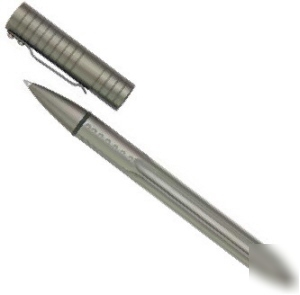
Timberline Tactical Lightfoot Combat Kubotan Pen LCP700
TimberLine TacticalLCP - Lightfoot Combat PenKubotan PenSelf Defense ToolLCP700
The perfect come-along, impact weapon, hand load...all in a completely legal functioning ink pen
Weight: 2.20 ounces (.06 kgs.)
Includes: 3 replacement O-ring washers
Greg Lightfoot set out to create a strong, reliable, discreet and light-weight writing instrument. The embodiment of his vision is the LCP Lightfoot Combat Pen. Made of strong lightweight aircraft aluminum with a fluted "barrel" and "ported" muzzle. It is comfortable in the hand and unnoticed in your shirt or jacket pocket. This is a must have accessory for all police and military personnel and executives who demand the highest performance in gear that they must rely on.
Takayuki Kubota is a law-enforcement specialist who created the Kubotan as a police aid. When used by an instructed individual, (I recommend a great book, "Kubotan Key chain: Instrument of Attitude Adjustment" by Takakuki Kubota published by Dragon Books) is a superior self-defense implement currently being carried by thousands of informed citizens world-wide.
The Kubotan is a self defense weapon of great effectiveness. This model is made of a very lightweight and extremely strong polymer known for its extreme durability. This easily maneuverable weapon is also absolutely reliable. The Kubotan is one of the most popular items for self defense, and is currently not illegal in any state to carry or conceal (double check your local laws).
You can use the Kubotan for stabilizing your fist while resisting sudden attack or while counter attacking an assailant yourself. It can be used to divert your assailant's attention. The Kubotan causes intense pain when it is used to apply pressure to sensitive parts of the assailant's body. It is also a useful device to help you gain leverage on the assailant's wrist or fingers, causing him to loosen his grip on you.
The Kubotan is handy, lightweight, and can be carried around with you wherever you go. Think for once - with all these features present in one weapon, don't you think the Kubotan is your best personal protection (next to my favorite... the .50 Dessert Eagle)?
What is the most common martial arts weapon in the united States? While weapons such as the PR-24 and extension baton have found growing acceptance in law enforcement circles, what about the general population? Undoubtedly, the most popular, and quite possible the most versatile personal defense weapon is the Kubotan. Carried by thousands of men and women, martial artists and non-practitioners alike, the Kubotan was developed by Shihan Tak Kubota, who based his invention upon the principles of the weapon than the key ring it often serves as, it retains all the striking and joint locking capabilities of the yawara stick.
A Karate oriented practitioner may prefer striking techniques, utilizing the ends of the Kubotan for painful blows to soft tissue areas or disabling blows to an opponent's vital points. Conversely, a JuJitsu or Aikido stylist may feel more comfortable with hooking, trapping, and pain compliance techniques, using the leverage and intense pain generated by the Kubotan to immobilize an adversary's limbs. Even for those without experience in a martial art, the Kubotan provides an economical and easily learned method of self-protection.
The most basic applications involve striking or poking vulnerable areas of the body with the Kubotan. generally speaking, swinging strikes work better against bony surfaces while fleshy areas are more susceptible to pokes and jabs with the ends of the Kubotan. With this concept in mind, a person avoids the confusion and frustration of trying to remember specific strikes for specific targets. Instead, one simply remembers to strike bones and poke nerve centers and pressure points. The Kubotan greatly intensifies the destructive power of any blow. Consequently, it is not necessary to waste time or miss an opportunity by trying to be overly precise. It is better to react naturally. For example, the fundamental objective of striking the arm may entail hitting the elbow; but it can also mean hitting the wrist, back of the hand, or the knuckles. There are many worthy targets aside from the arm. The shin, hip bone, collarbone, ankle, and kneecap are all desirable targets. A sharp crack to a bony area will prompt an assailant to discontinue his attack. A harder, well placed blow can easily break bones-especially if the force of the blow is not diminished by clothing.
Kubotan strikes are most effective at medium range such as when an assailant reaches out to grab or push his victim. The extending limb can be disabled with a quick, snapping strike. The tactic also works against a punch or kick. When the opponent attacks, move away and meet his technique with a quick flick of the Kubotan. the blow does not have to be perfect; since the nerves are so close to the surface of most bony areas, even a glancing blow will inflict enough pain to make your attacker regret his actions.
If an attacker has already managed to grab onto an individual, he or she can break the hold by pressing or poking the Kubotan into whatever target presents itself. Although one's movements are restricted when caught in a headlock, bearhug, or choke, Sensei Freedman recommends jamming the tip into whatever part of the attacker's anatomy that you can reach. "There are no wrong movements; make a technique work from the position you find yourself in," counsels Freedman. Accordingly, a hard thrust with the Kubotan to the kidneys, ribs, or sternum can devastate an attacker and damage internal organs.
Since there are such a wide variety of ways to use the Kubotan, there is no one correct way to hold the weapon. Different strikes require different grips and much depends upon an individual's personal preferences. According to Kubotan Instructor Sensei Freedman, how one holds the Kubotan depends entirely upon the situation. "If you're pinned from behind, you might want to hold it like an icepick to stab backwards. Another option for poking is to place the kubotan loosely so that it can slide through the hand." Freedman also stresses using not only the Kubotan itself but the keys that are usually attached. "You can hold onto the keys that are usually attached. "You can hold onto the keys and swing the Kubotan; or you can grip the Kubotan and swing the keys. You can also hold the Kubotan and drive the keys into an attacker's face."
For those proficient in martial arts that emphasize grappling and joint locks, the Kubotan provides added leverage. Wrist locks, arm bars, come-alongs, chokes, and leg locks instantly become more agonizing with the Kubotan. The Kubotan can be used to dig into the wrist or elbow joint. Similarly, a captured leg can immobilized with grinding pressure to the ankle or knee. In life threatening circumstances, the Kubotan can intensify choking techniques and, if need be, crush an assailant's trachea. Indeed, nearly all joint locking techniques common to Jujutsu and Aiki-Jutsu become easier to apply with the Kubotan. The weapon's rigidity makes it much more resistant to an opponent's efforts to power out a hold or lock. Obviously, a fundamental knowledge of anatomy and the body's lever points are necessary to make these techniques work-with or without a Kubotan. However, for those who have such a knowledge, the Kubotan reinforces these techniques and makes them more disabling.
The Kubotan is also valuable for snagging limbs before or after applying a striking technique. By holding the weapon with several inches protruding, you can hook a part of the attacker's body with the Kubotan and then follow up with an immediate strike. You can reverse the process and strike first, hooking the neck or wrist to control the opponent's balance. In effect, the Kubotan enables an individual to literally lasso a foe's head, forcing it downward, backward, or to the side. A person's body will follow in the same direction that his head is being jerked, thereby making him extremely vulnerable to any number of finishing techniques.
Make no mistake, the Kubotan is not a magic wand. But it is one of the few conceivable martial arts weapons that is legal and entirely unregulated. There is a reason, of course. Despite its popularity among martial artists, to most people, the Kubotan is little more than a nondescript key ring. Even for those in the martial arts and law enforcement communities who recognize its potential, the Kubotan does not invoke the unsavory connotations and legal difficulties of many other edged and impact weapons. While the Kubotan is not particularly intimidating, like its ancestor, the yawaram, it remains a superbly versatile instruments for self defense. Although it requires a modest amount of training to develop competence, in the right hands, the Kubotan truly becomes a fistful of dynamite.
Summary of Our Selling Policies
French President Sarkozy Says in French What United States Politicians Don't Say in English
November 7, 2007 addressing a joint meeting of the House and the Senate
To the millions of men and women who came from every country in the world and who, with their own hands, their intelligence, and their hearts, built the greatest nation in the world, America did not say, "Come, and everything will be given to you." Rather, she said, "Come, and the only limits to what you will be able to achieve will be those of your own courage, your boldness, and your talent."
The America that we love throughout the world embodies this extraordinary ability to grant each and every person a second chance, another chance - because, in America, failure is never the last word. There is always another chance. Here, in your country, on this soil, both the humblest and the most illustrious citizens alike know that nothing is owed to them and that everything has to be earned. That is what constitutes the moral value of America.
America liberated us, and this is an eternal debt we owe America.
Every time, whenever an American soldier falls somewhere in the world, I think of what the American army did for France. I think of them, and I am sad as one is saddened to lose a member of one's family.
repair--parts.com bears NO responsibility for this ad. Please report ads that do not follow our
rules (on front page).
Posted By: Faith Wilkerson
Contact: Faith.Wilkerson@repair--parts.com (Faith Wilkerson) (this is a temporary forwarding address).